
Force torque sensors
Total 4 .
Q4[About Force Torque Sensors] What do resolution, hysteresis, and crosstalk mean in a force torque sensor?
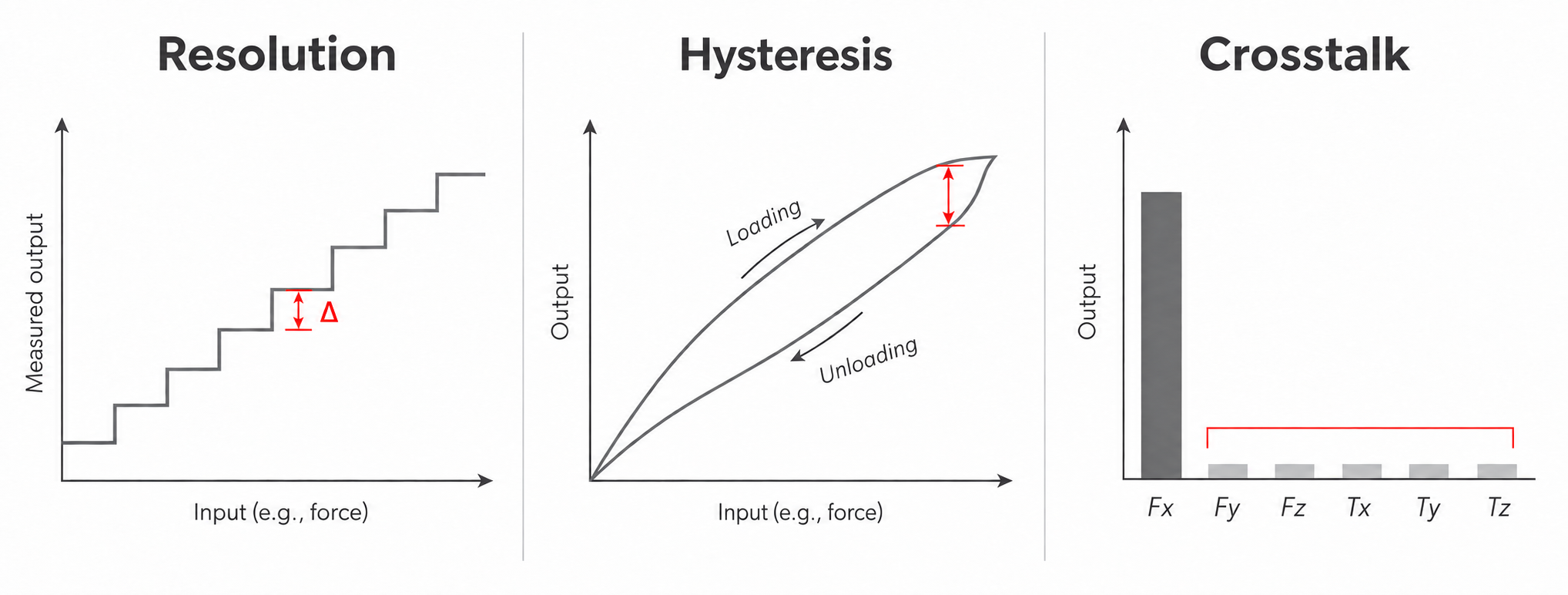
Resolution, hysteresis, and crosstalk describe different aspects of a force torque sensor’s measurement performance. Resolution indicates the smallest detectable change, hysteresis describes the difference between loading and unloading measurements, and crosstalk indicates how a load on one axis affects the outputs of other axes.
Resolution
Resolution is the smallest change in force or torque that the sensor can detect. Higher resolution enables the sensor to detect lighter contact and smaller variations in applied force. However, high resolution alone does not necessarily guarantee high accuracy.
Hysteresis
Hysteresis is the difference in sensor output at the same applied load depending on whether the load is increasing or decreasing. Lower hysteresis helps the sensor provide more consistent measurements when the force direction or load level changes.
Crosstalk
Crosstalk is the unwanted output generated on other measurement axes when a force or torque is applied to one axis. For example, a force applied along the Fx axis may produce small outputs on Fy, Fz, Tx, Ty, or Tz. Lower crosstalk allows the sensor to distinguish forces and torques on each axis more clearly.
These specifications should be evaluated together with measurement range, accuracy, noise, overload capacity, and environmental conditions when selecting a force torque sensor.
To review the resolution, hysteresis, crosstalk, and other technical specifications of Robotous sensors, download the relevant product datasheet from Resources > Datasheet.
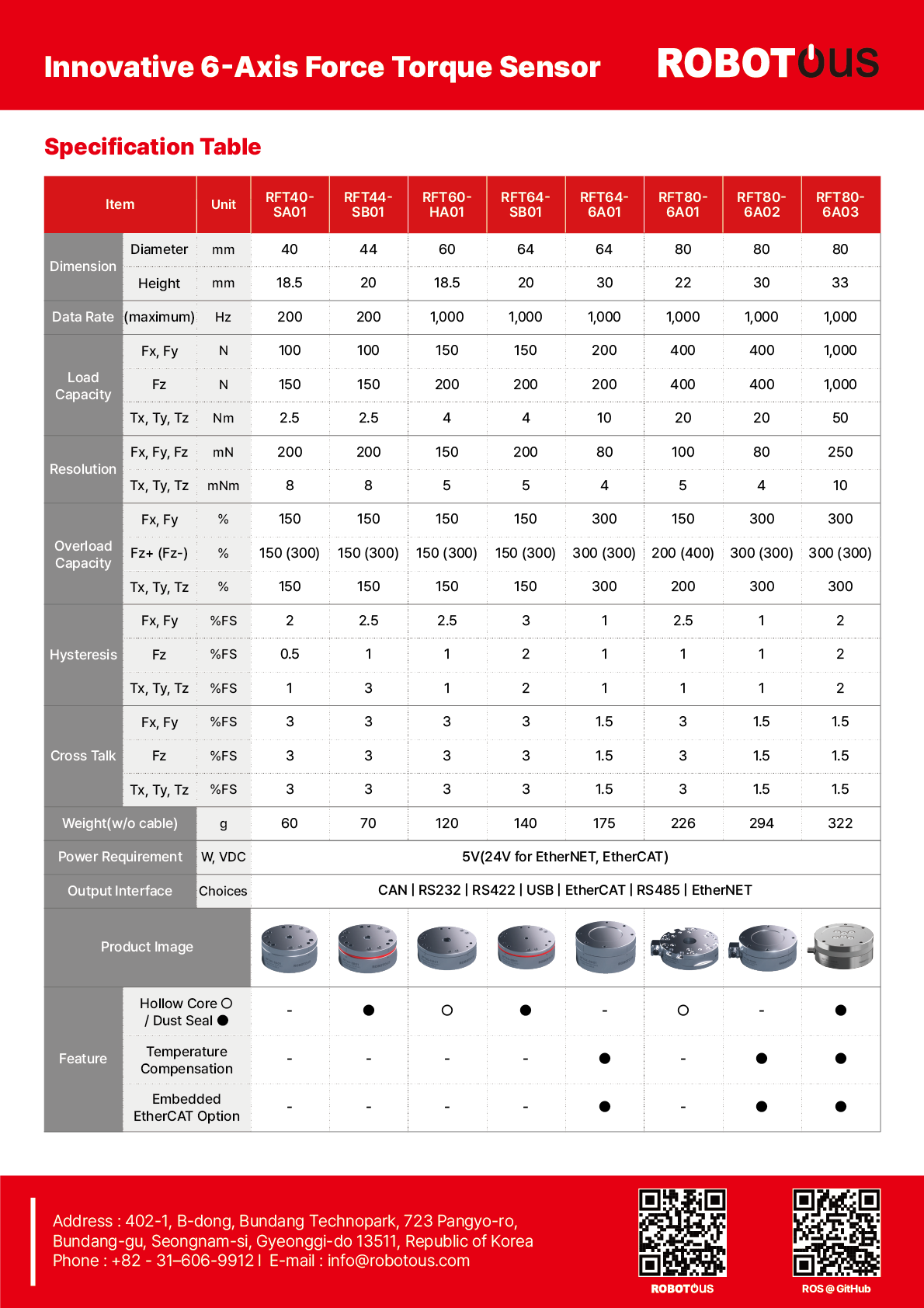
Here is the product specification table for your convenience.
Q3[About Force Torque Sensors] How does a force torque sensor work?
Force torque sensors don't rely on guesswork. They capture precisely what's happening during a robot's motion and respond in real time.
Here's how it works:
√ Sensing the pressure : Strain gauges or piezoelectric elements pick up on forces and torques, translating them into electrical signals.
√ Informing the robot : That data gets sent to the robot's control system, enabling smooth, precise movement.
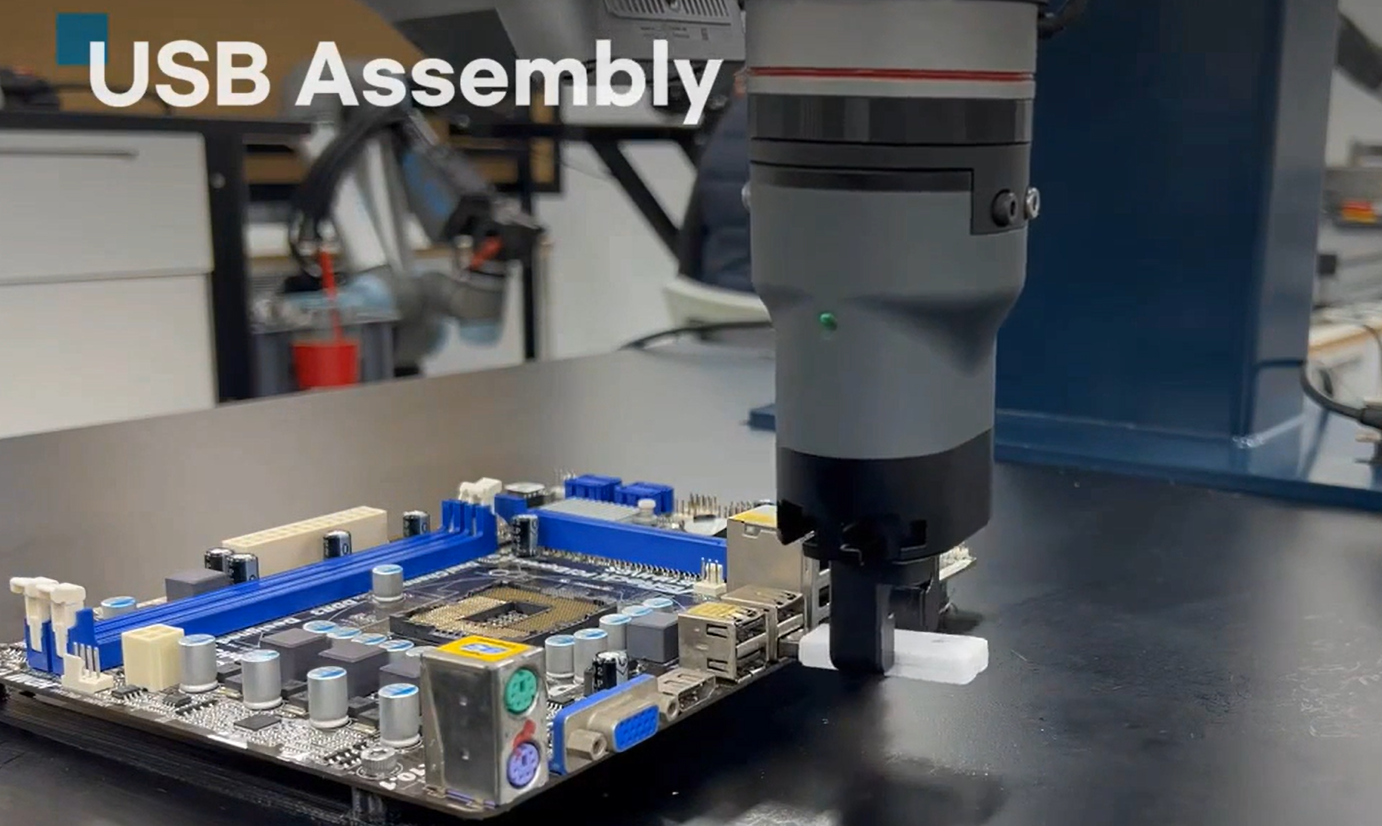
√ Mastering delicate tasks : Thanks to this real-time feedback, robots can handle tasks that require a light, exact touch — like plugging in a USB connector just right or polishing a surface with the perfect amount of pressure.

Q2[About Force Torque Sensors] What does a 6-axis force torque sensor measure?
A 6-axis force torque sensor simultaneously measures three linear forces—Fx, Fy and Fz—and three rotational moments—Tx, Ty and Tz.
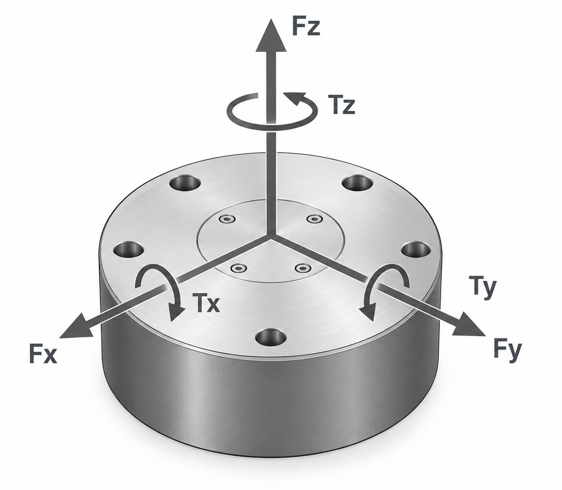
The force components indicate pushing or pulling along the X, Y and Z axes and are generally expressed in newtons (N). The moment components indicate twisting or bending around each axis and are expressed in newton-metres (N·m).
These six measurements allow a robot to determine both the direction and magnitude of contact acting on its end-effector, enabling precise force control, contact detection and motion adjustment.
Q1[About Force Torque Sensors] What is a force torque sensor?
A force torque sensor is a device that measures the forces and torques applied to an object. A 6-axis force torque sensor simultaneously detects three linear forces—Fx, Fy and Fz—and three rotational moments—Mx, My and Mz.
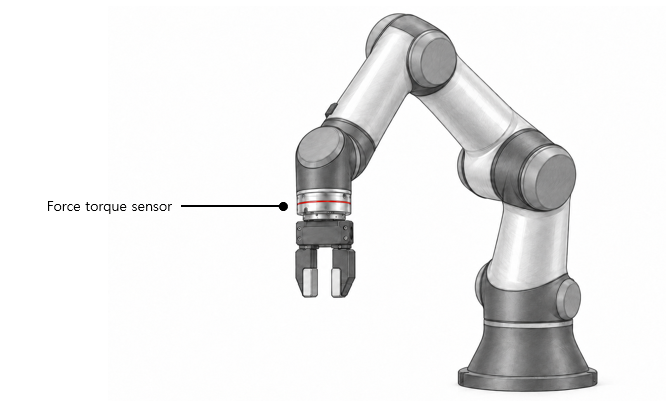
It is typically installed between a robot wrist and an end-effector, allowing the robot to sense contact with its surroundings. This real-time feedback enables precise force control in applications such as assembly, polishing, grinding, inspection, medical robotics and collaborative automation.